The Multi-step Path to a Better U.s. Beef Supply
What is a supply chain?
A supply chain is the network of all the individuals, organizations, resource, activities and technology involved in the creation and sale of a product. A supply chain encompasses everything from the commitment of source materials from the supplier to the manufacturer through to its eventual delivery to the end user. The supply chain segment involved with getting the finished product from the manufacturer to the consumer is known as the distribution aqueduct.
Steps in the supply chain
The fundamental steps of a supply concatenation in order are every bit follows:
- Sourcing raw materials.
- Refining those materials into basic parts.
- Combining those basic parts to create a product.
- Order fulfillment/Sales.
- Product delivery.
- Customer support and return services.
The amount of time it takes any i of these processes from kickoff to completion is known as pb fourth dimension. Supply chains are managed by supply concatenation managers, who monitor pb time and coordinate the processes in each step to maximize customer satisfaction.
Supply chains can be contrasted against value chains -- they contribute to the finish product in different ways. Supply chains aim to run into customer demands. Value chains seek to add together value to a production on top of its inherent value. The purpose of the value chain is to requite the visitor a competitive advantage in the industry. Supply chain management and value chain direction are two slightly different perspectives on the same basic process and piece of work in tandem to run into two slightly different definitions of "demand."
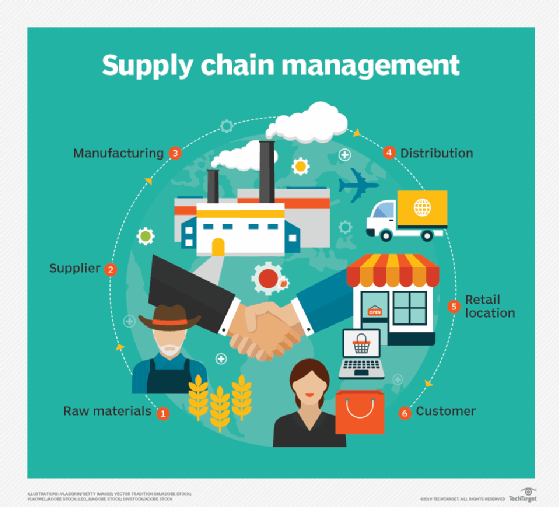
Supply chain direction
Supply chain management (SCM) is the oversight of materials, information and finances as they move in a process from supplier to manufacturer to wholesaler to retailer and then to the consumer. The 3 primary flows of the supply concatenation are the production catamenia, the information catamenia and the finances flow. These occur across three main stages: strategy, planning and operation. SCM involves analogous and integrating these flows both within and among companies.
Supply chain models
In that location are several common supply concatenation business models that supply bondage fit into. The models have ii chief focuses: responsiveness and efficiency. Each model strives for some combination of both but approaches those goals differently. In addition, models tend to favor one over the other. Organizations tin can evaluate the value proposition of each in relation to their goals and constraints, and choose which suits them best.
The model types are:
- Continuous catamenia model -- works best for mature industries with a caste of stability.
- Agile model -- works best for industries with unpredictable need and products that are made to order.
- Fast chain model -- works best for products with a curt lifecycle, such equally fashion items.
- Flexible model -- works best for industries with a level of stability and a few relatively predictable demand peaks.
- Custom configured model -- focuses on customizing.
- Efficient concatenation model -- works best for highly competitive markets in which pricing plays a big office.
The models are discipline to overlap and should be designed by the supply chain manager to fit the unique supply chain.
Supply concatenation challenges
Modern supply chains are complex and present several common challenges. These are:
- Potential lack of transparency. Having transparency enables stakeholders to understand the status of the supply chain.
- Waste product due to inadequate product bicycle. Businesses that inaccurately gauge their supply, demand or capabilities may end upward with an overstocked inventory.
- Unsatisfied business partners and customers. The ultimate goal of SCM is to meet customer expectations. This involves managing those expectations realistically, only likewise providing a valuable production.
- Lost or delayed goods. Goods that go missing at any point in the concatenation ultimately delay the whole procedure and can impact customers negatively.
- Increasing customer expectations. New technology and businesses raise customer expectations, which can be difficult to manage, and incommunicable to meet if not properly managed.
- Resiliency to sudden changes in the supply chain. External factors can cause unforeseen changes in a supply chain, so best practice is to prepare for the unexpected and be able to pin if demand be.
Supply chain best practices
Supply chain managers need to arrange to the growing speed and calibration of the global marketplace. Best practices for doing this include:
- Apply lean SCM and logistics techniques. Lean increases flexibility and minimizes inventory waste.
- Increment inventory velocity. Companies need to ensure their supply doesn't outweigh demand, and that they can capitalize on distributed, quickly changing need. Lean is one way to practice this.
- Enterprises demand to collaborate with other businesses in their supply chain to optimize the entire chain, not just one visitor'southward process. The relationship with suppliers is especially important.
- Shorten cycles. Equally supply chains become more complex, they go longer, and then exercise processes. Businesses should aim to continue them as short as possible to meet client expectations.
- Utilize supply chain technology. Applied science allows managers to integrate their supply chains and interact more effectively.
- Implement useful metrics. Well-defined metrics allow managers to accurately gauge the efficiency of the concatenation.
The evolution and time to come of the supply chain
In the 1980s and 1990s, increasing globalization, outsourcing and availability of data spurred the demand to integrate concern processes across the entire global supply chain, which resulted in the idea of supply concatenation management. This marked a shift from the traditional supply chain, which only involved the basic logistic steps of production. With the integration, companies gained more visibility in steps following and preceding theirs in the chain, and each company involved in a supply concatenation became focused on optimizing the unabridged concatenation instead of just their local procedure.
Equally such, market contest dynamics changed as well. Instead of individual companies in competition, entire chains consisting of several enterprises would compete, as company investment in their respective chains grew. Enterprises began to outsource manufacturing and logistics processes to third-political party companies.
The increase in visibility as a effect of globalization and advancing engineering science had benign furnishings for businesses, such every bit improved production traceability and social responsibleness efforts.
Since then, the evolution of internet businesses, the internet of things (IoT) and mobile computing accept changed the manner customers social club products and the way businesses piece of work. The internet enables customers to straight contact product distributers. This has consequently shortened the supply chain by removing some middlemen and encouraged collaboration.
Still, internet businesses like Amazon accept raised customer expectations for delivery times and convenience. Normalizing features like adjacent-solar day delivery may increase social club fulfillment efficiency, but too puts stress on other parts of the chain. Considering orders tin be made and received faster, they demand to be delivered at an equally accelerated step. This oftentimes leads to waste as companies over-social club materials and and then confront a lower volume of orders. Motorcar learning, artificial intelligence and automation, among other technologies, have helped companies increase responsiveness to come across this increasing demand.
Traditional supply chains had a more localized, bottom-up approach that dictated work closer to the supplier. Amazon'due south astern vertical integration represents the reverse approach, in which the company started as a retailer and worked astern to become a publisher and fractional owner of its distribution channel.
The COVID-19 pandemic has accelerated the diverse sourcing trend and placed an increased emphasis on inventory management and visibility. Machine learning and artificial intelligence will play an increasingly big part in diversifying supply modify and improving the responsiveness and resiliency of supply bondage, likely continuing later the economic shock from the pandemic has passed.
The pandemic may also cause economies to restructure their supply chains away from ultra-lean models that rely heavily on flexibility and network interconnectedness to provide product chop-chop.
This was last updated in June 2021
Go along Reading Virtually supply chain
- Supply concatenation risks can be costly if companies fall behind
- RPA, AI bolster supply chain resilience in times of crunch
- Supply chain disruptions force companies to rethink strategy
- How Infor Nexus is helping to digitalise Asia's supply concatenation
- Promote business continuity with IoT supply concatenation direction
Source: https://www.techtarget.com/whatis/definition/supply-chain
0 Response to "The Multi-step Path to a Better U.s. Beef Supply"
Post a Comment