Upload File to Root of the Web
This page tells you what you need to know to upload files to your spider web server and mange them using FTP, which stands for File Transfer Protocol, in case you lot wonder. More specifically (or as an example), nosotros'll show you how to upload all the folders & files making upwards the b2evolution CMS package onto your web server.
1. You lot need an FTP client
Your web hosting account may come with an FTP tool that runs in a web browser window. If that works for you, fine. But the odds are you volition hit the limits of that tool within the showtime 5 minutes of you trying to use it. So you might also get yourself a real FTP client.
It's chosen an FTP Client, because at that place is a Server and a Client. The Server is your web server (which includes an FTP server). The Client is a piece of software yous will install on your computer. The client will then connect to the server and tell it to practice what you demand information technology to do.
Although you might never have heard of them, there are many FTP clients available. A good free choice for Mac, Windows and Linux is Filezilla. We'll utilize this in our example.
In that location are paid tools which wait much better. On Mac OS X we like to use Yummy FTP lite (Gratuitous Trial!) or Transmit.
So make your choice, download and install an FTP customer on your estimator.
2. Connect to your server
Your web host will have given yous:
- an FTP hostname
- an FTP username
- an FTP password
- sometimes an FTP port only this is pretty rare
Merely copy and paste each of these strings advisedly into the "Connection" dialog box of your FTP client. With FileZilla, it looks similar this:

- the FTP hostname
- the FTP username
- the FTP password
Once you've entered the info, click "Connect" or "Quickconnect" every bit Filezilla calls it (four).
Note: you can save all this info in an address volume if you oft need to connect to unlike FTP servers, but this is beyond the scope of this guide.
3. Get acquainted with the interface
There is a best practice among FTP client to present your local files (what's on your computer) on the left and remote files (what'due south on your server) on the right.
You can see this on the screenshot of FileZilla above.
On each side FileZilla shows y'all 2 panes: you have a directory construction on top and a listing of files below. You can employ the directory structure to navigate your hard drive and find the folder you lot're interested in. Once y'all select a folder y'all tin see its contents in the pane below.
Yummy FTP has a slightly different view but information technology boils down to the same concepts:
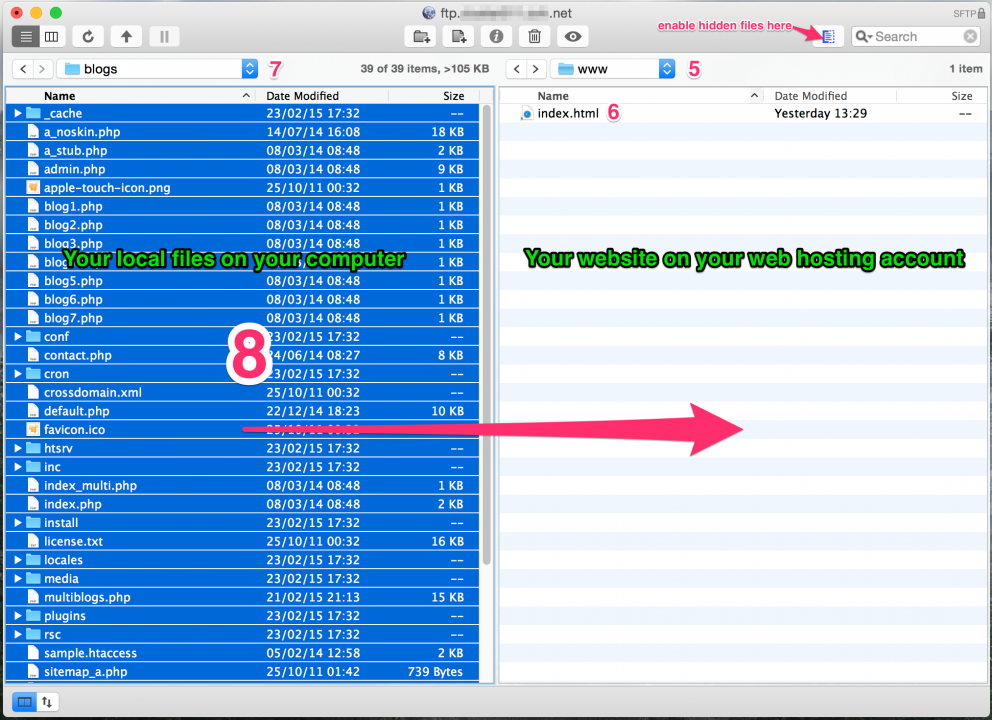
4. Starting time by finding the root of your website
On the correct side, you see your web hosting account. Note that by default you are connected to the root of your account which is not the same every bit the root of your website.
Your website actually lives in a binder that is typically called www or public_html. If you lot come across both, one is an alias of the other, and so yous tin simply go with world wide web.
Select that folder (step v on the screenshot) to see its contents.
Inside of the www folder you will probably see files that take been placed at that place by your web host. Most of the time you lot will come across a file called index.html (marked 6 on the screenshot). This is typically the file that displays "This site is under structure" until you put something else in that location.
5. Clean up
We recommend you start by deleting the index.html file likewise as whatsoever other file that may be inside of your web root (the world wide web folder). Practice Not bear upon the files outside of www.
In FileZilla yous can delete a file by selecting it and pressing the Delete key. You can also select it and then right-click on it and select "Delete" from the contextual card.
Of import: nosotros also recommend you enable "show hidden files" in your FTP client (if it'south not enabled by default) and that you delete the .htaccess file that is pre-installed on your spider web hosting business relationship. This will ensure that b2evolution can install its ain custom-tailored .htaccess file.
6. Upload b2evolution to your server
Now, on the left side, find the b2evolution folder on your hard bulldoze. This is the version of b2evolution y'all take previously downloaded and unzipped.
On near modernistic computers, y'all will need to kickoff by going into the directory /Users/ in order to detect your files.
Inside your b2evolution binder, you volition find the files that you want to upload to your website. This includes folders similar:
-
conf -
cron -
htsrv -
inc -
install– Note: this is where the install script is (you'll telephone call it later) -
locales - etc.
And also files similar:
-
index.php -
sample.htaccess - etc.
Select all these folders and files on the left pane. Then drag and drib them into the correct pane!
Now merely look at FileZilla doing the work of moving all these folders and files recursively onto your website. b2evolution is made of more and so 2000 files. It should take between thirty seconds and ten minutes to upload them all, depending on the speed of your net connection.
Pro Tip: The upload speed will greatly depend on the number of concurrent connections you tin make to your server. A good target is 10 concurrent connections. For technical reasons beyond the scope of this tutorial (handshaking delays, IP protocol windows…), concurrent/parallel uploads are much more efficient than serial uploads. The number of concurrent connections depends on your FTP software (how well it handles multiple threads) but also, and more chiefly, on the limits fix past your webhost. You can find such limits in our webhosting matrix.
Pay attention if in that location are errors though. This probably means your Internet connection is not very good, or your spider web host is overloaded. In FileZilla, at that place is a "Failed transfers" at the bottom. If you see failed transfers in there, b2evolution won't be working. You lot need to restart 100% of the failed transfers. If you take a doubt, you can also re-upload everything (by overwriting the files that were already on the server).
Tip: if you keep getting errors, attempt this operation outside of the tiptop hours. Late a nighttime or very early in the morning might work all-time.
7. Extra credit
You may never demand this, merely find that on the remote files pane there is a cavalcade called permissions where in that location is a code similar to 0777 or 0755 for each file. These are the UNIX file permissions. If you run into file permission problems later, this is where y'all need to look.
What now?
If you're trying to install b2evolution on your server, uploading the file is merely one role of the procedure. Delight refer to the Installation Guide for more details about creating the database and running the installation script.
Source: https://b2evolution.net/web-hosting/blog/tutorials/ftp-101
0 Response to "Upload File to Root of the Web"
Post a Comment