Family Medicine of Margate: Washington Niermala Md Margate, Fl
Syringes were invented long before hypodermic needles. Their origins are found in Greek and Roman literature where there are descriptions of hollow reeds for the ritual of anointing the body with oil, and as musical instruments using a plunger to modify the pitch. Simple piston syringes for delivering ointments and creams for medical use were described by Galen (129-200 CE) and an Egyptian, Ammar bin Ali al-Mawsili, reported using glass tubes to apply suction for cataract extraction from near 900 CE. In 1650, Pascal's experimental work in hydraulics stimulated him to invent the first modern syringe which allowed the infusion of medicines. Christopher Wren (amend known equally an architect than for his medical training), used a 'cutting-downwardly' technique to intravenously inject dogs with poppy sap through goose quill canulae. By 1660 Drs Major and Esholttz used this method on humans with similar fatal results due to ignorance of suitable dosage and the need for sterilising utensils and the infusion. The disastrous consequences of these experiments delayed the use of injections for 200 years.
The first hypodermic needle was probably made by Francis Rynd in Dublin in 1844, using the applied science of annealing the edges of a folded apartment strip of steel to make a tube. This was then drawn through increasingly narrower dies whilst maintaining the patency of the needle. The bevelled signal is cut and basis, and and then the hub is added with its diverseness of fittings and locks. A syringe has three elements, the barrel (glass, plastic or metal), the plunger and the piston which may be of rubber, mineral, metal or synthetic textile but in early on examples waxed linen tape or asbestos was wound on a reel to obtain a watertight seal. Charles Pravaz, in France, administered coagulant to sheep in 1853, but information technology seems that Alexander Forest in Edinburgh combined a functional syringe with a hypodermic needle in the aforementioned year, to inject morphine into humans and probably should be credited with inventing the technique. The basic design has remained unchanged though interchangeable parts and the use of plastic resulted in the almost universal use of disposable syringes and needles since the mid-1950s.
Looking to the time to come of the parenteral administration of medicines and vaccines, information technology'southward probable that there will be increasing use of direct percutaneous absorption, especially for children. Micro-silicon-based needles, so small-scale that they don't trigger pain fretfulness are beingness adult, however, these systems cannot deliver intravenous or bolus injections and then hypodermic needles, with or without syringes, are likely to exist with us for a long fourth dimension. They are likewise required for catheter-introduced surgical procedures in deep anatomical locations.
Some needles from the collection:
Figure i shows three generations of needles. The top left ones are single-employ needles from the 1950s with diverse lengths and gauges. At the top right is small sample of needles of a currently used type, supplied in a patent wrapper in their individual protective sheathes, with colour coded plastic hubs. Below these are the 1930s screw-on double ended needles patented by Boots & Co Ltd to fit their cartridge loading syringes. The internal betoken pierced the safety bung on pre-dosed cartridges which could be inserted in the patent syringe.
The range of needles is extensive. Each manufacturer produced a different shaped hub. Also, the taper of the nozzle was not-standard though most used were the 'Luer' and and then the more tapered 'Record' but in addition to this were dissimilar locking devices to fit different syringe nozzles. The approximate and length of needles varies greatly according to their purpose. Figure 2 illustrates infusion needles in which the bulbous hub fits straight on to rubber tubing. Pneumothorax needles are for withdrawing air from the pleural crenel. The side arm allows for the attachment of a suction bottle using a two-way tap. The Hamilton Bailey blazon infusion canulae needles are eight from the early 20thcentury, made of gold for sterility, with slots through which to thread a back up tape. Figure iv. Shows aspiration needles. They take a bevel-pointed introducer to facilitate insertion of the needle.
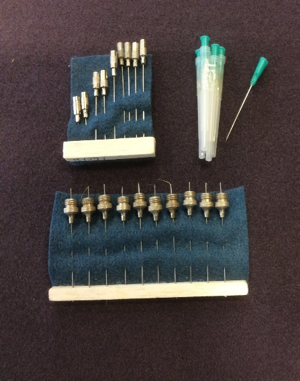
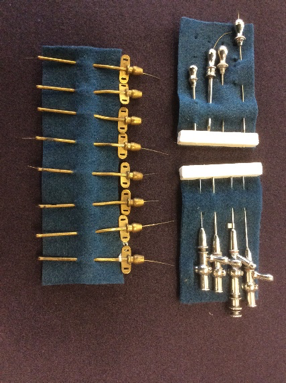
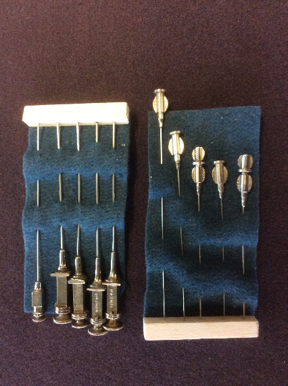
Effigy 1. Effigy 2. Effigy 3.
Figure four below, shows two unused, 'Gord' type, infusion needles. Both are fitted with detachable safe diaphragms to make repeated intravenous injection easier. With several minor variations they were used for many years until the 1960s when single use 'Butterfly Needles' were introduced.
Figure 5: This is a 1930s portable lumbar puncture set used to measure the pressure of and examination the cerebrospinal fluid which flows when the spinal meninges have been punctured.
Figure six: Haemorrhoid needles are characterised by a shoulder on the haft a few millimetres short of the needle tip to prevent deep penetration when injecting the haemorrhoids. A secure needle-lock ensured that the increased pressure required to inject the viscid oil did non detach the needle.


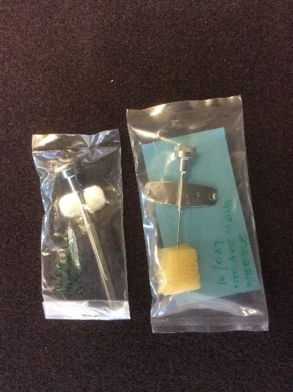
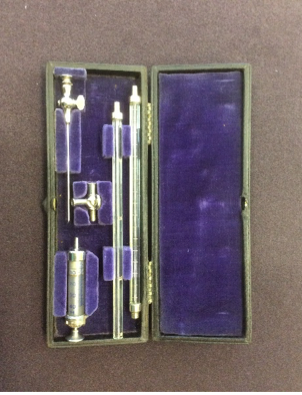
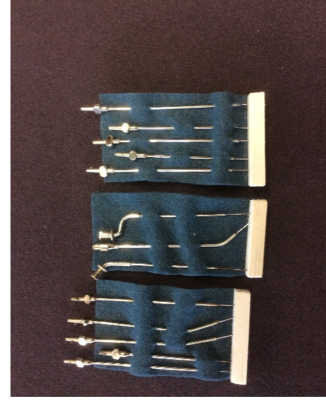
Figure iv. Effigy v. Effigy 6.
The needles pictured below represent the range of needles and packaging which were commonplace between 1920 and 1950. They often became blunt with multiple use, were impossible to clean and sterilise fairly and caused infections leading to cellulitis and abscesses. Sharpening needles was sometimes solved by including a suitably shaped carborundum stone in the injection fix. Needle sharpening devices were needed for rapid and consistent sharpening of many needles by big institutions (Figures 7. & eight.).

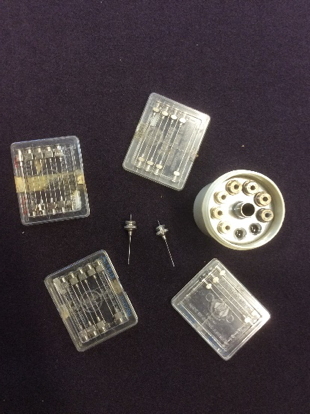
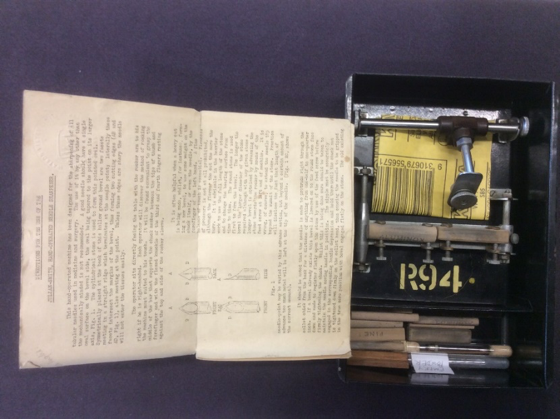

Figure 7. Effigy eight.
Syringes and Injection Sets:
The Mussel Beat (Figure 9.), a pocket-sized syringe gear up, was patented by Burroughs Welcome, nearly 1910, particularly for use with tabloids, containing a standardised dose of soluble preparations to be injected later dissolving in distilled h2o. It was not until later that pharmaceutical manufacturers prepared sterile injections in sealed glass ampoules. Probably the oldest syringe in the collection (c1875) has a small metal barrel with a patently glass tube to contain a medication. Information technology is crude and has a waxed linen piston with thumb-agree on the plunger. The needle has a screw fitting like some other of the older syringes in the collection with its ferrous metal ends and non-sterilisable, ivory pollex piece on a plunger with a condom piston. (Figure 11.)
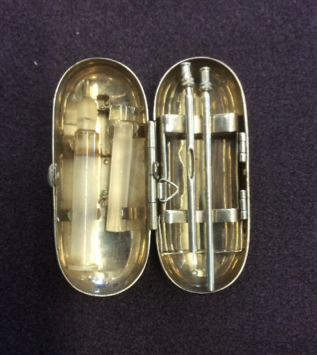

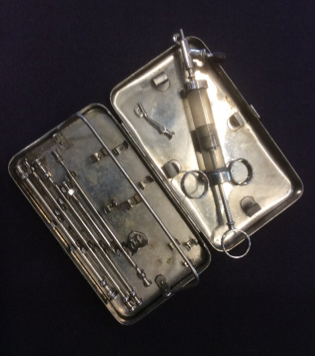


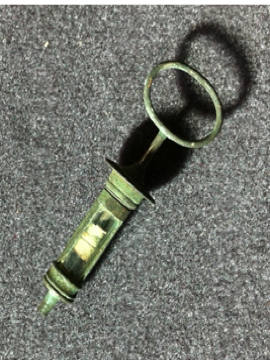
Effigy 9. Effigy x. Effigy eleven.
At that place were a variety in syringes fabricated from all glass to all metal, merely the Rekordspritze introduced by the Berlin instrument makers Dewitt and Hertz in 1906 gained prominence through its dependability, lack of leakage and jamming, and ease of dismantling to enable sterilisation. This pattern persisted until plastic superseded it. It was manufactured past many companies with minor modification all over the world. All drinking glass syringes retained some popularity but were more susceptible to jamming and leaking (Figure 13.). Cartridge syringes were pop with dentists, and for emergency kits (Figure 14.).

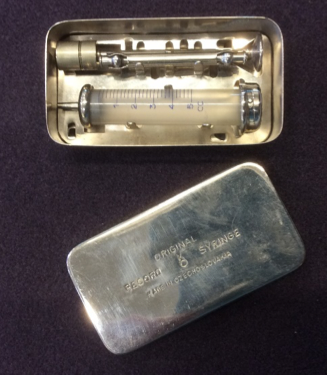
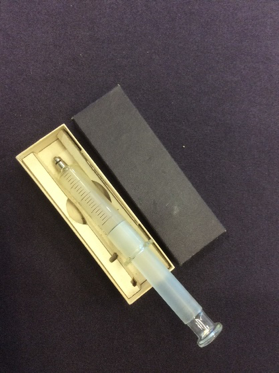
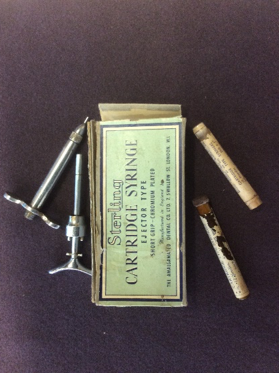
Figure 12. Figure thirteen. Effigy 14.
The collection contains several special purpose syringes and syringe sets. The anaesthetic syringe fix was in common utilise past GPs and specialists. (Figure 10.). One that took us a while to identify is shown in Figure xv. The copper cased cannulas and the thick metal syringe with a robust screw lock retain heat to enable the injection of melted paraffin wax into hollow organs and vessels for demonstration specimens for morbid anatomy classes. Another unusual syringe is the AGLA Micrometre Syringe Outfit shown in Effigy 16. This was designed for analysis of diluted concentrations of biological fluid components where accurate measurement of precise quantities is required. The enclosed booklet suggests that it was particularly used in immunology research and assessment where series dilutions are critical, but toxicology would suggest itself as another application.
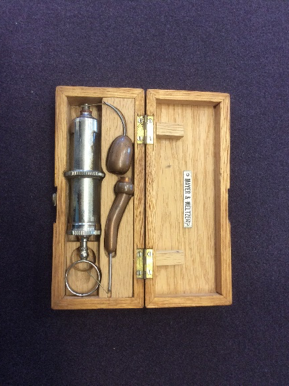


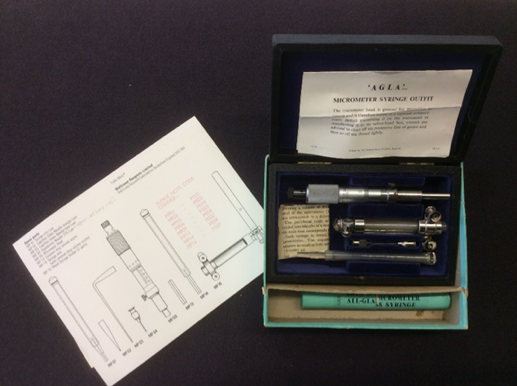
Figure 15. Figure sixteen.
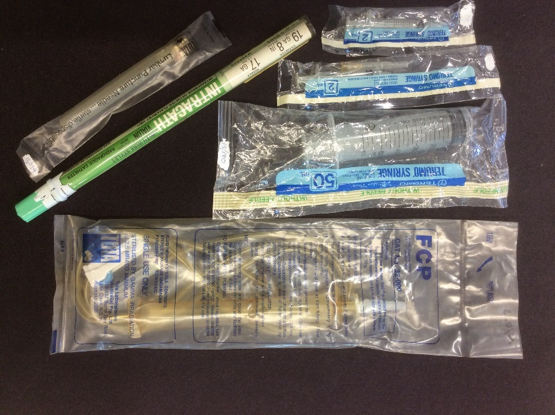
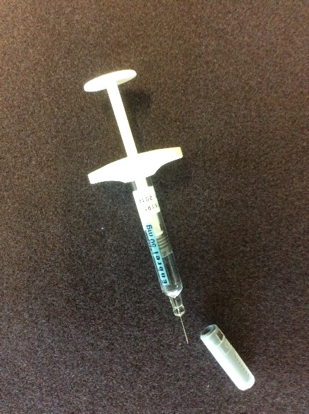
Needles and syringes were routinely sterilised in sets, usually past simple boiling but in clinics and hospitals autoclaves were used to obtain college temperatures. Syringe sets enabled the not-interchangeable components to be kept together. Single use items now boss the products though occasionally glass may be used in preference to plastic because of the characteristics of the substance to exist injected. All the same, most syringes, intravenous giving sets and intravenous catheter placement sets are made from plastic with stainless steel needles, wrapped in cellophane and sterilised using gamma irradiation (Figure 17.). Expensive modern biological pharmaceuticals are often distributed in a single dose syringe with, plastic and rubber plunger with a sealed needle incorporated into the glass barrel for cocky- administration. This means the syringe is the container for the medicine and reduces the chance of wastage (Figure 18).
Effigy 17. Figure 18.
Source: https://medicine.uq.edu.au/blog/2018/12/history-syringes-and-needles
0 Response to "Family Medicine of Margate: Washington Niermala Md Margate, Fl"
Post a Comment